CONSTRUCTION, NOT CHERNOBYL
Featured at the 2026 Canadian CBRNE & Robotics Summit · Instructors: Joey Pordash · April 21, 2026
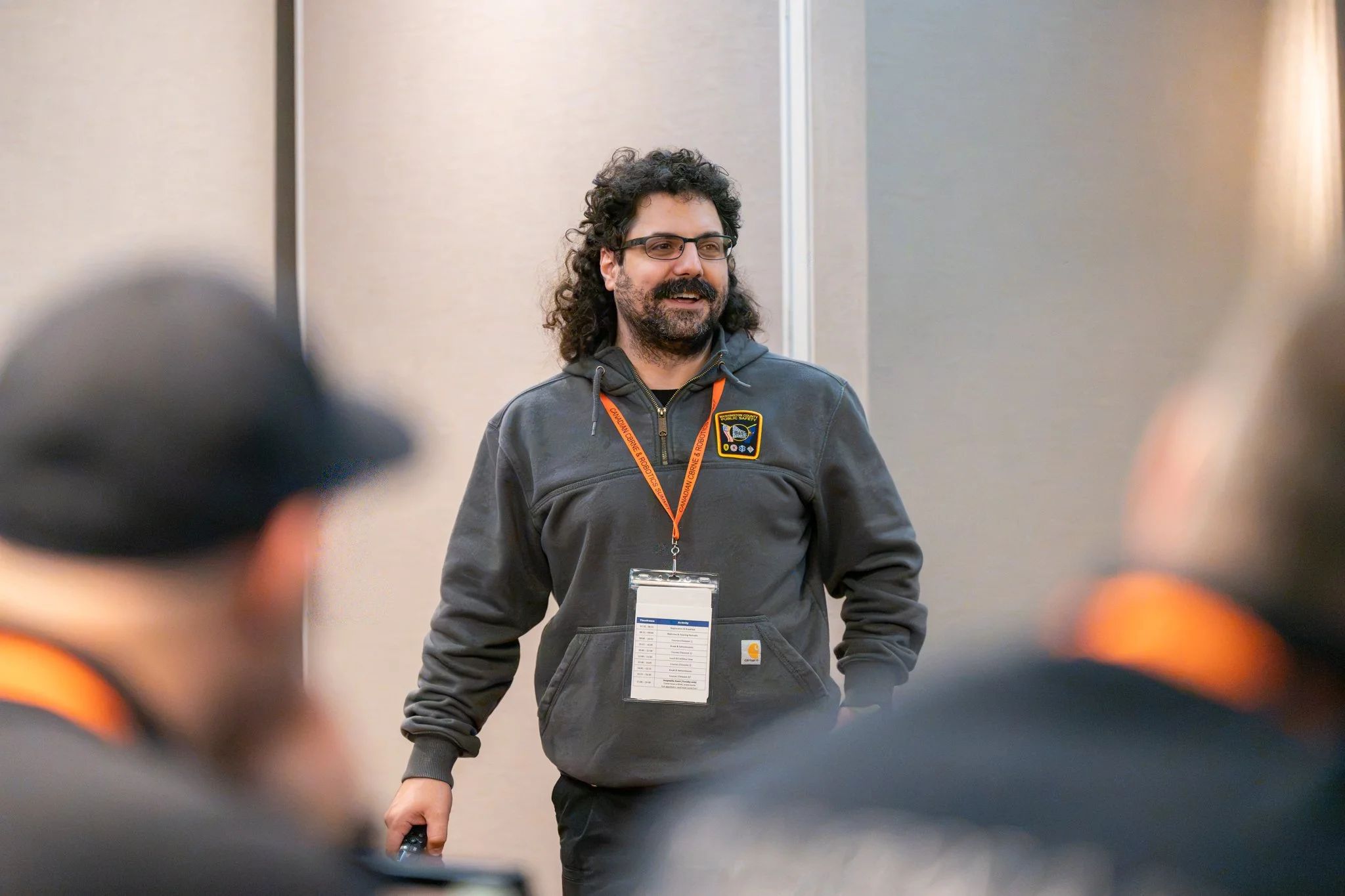
it’s a density gauge in a stolen pickup — not a warhead on a runway train.
Photograph by DIGRUCC.IO at the 2026 Canadian CBRNE & Robotics Summit
The radioactive emergency you'll actually run isn't a meltdown.
It's a pebble-sized source in the back of a work truck — and the real risk is how your crew reacts to it.
Ask a room of responders to picture a radiation emergency and you'll get the same movie every time:
Three Mile Island, Chernobyl, a warhead smuggled onto a runaway train. Great cinema. Almost nothing to do with the call you'll actually run.
Here's what the real one looks like.
Every year around 3 million packages of radioactive material move across US roads, rails, and airspace — and worldwide the IAEA puts it near 10 million shipments, of which roughly 95% are the boring stuff: smoke detectors, medical isotopes, industrial sources. Radioactive material is under 5% of all hazmat shipments, and the odds of a transport accident actually releasing any of it sit somewhere around one in a billion. The runaway-train scenario isn't rare. It's fiction.
What isn't fiction is the humble nuclear density gauge.
It's the yellow box you've driven past on every road job — a portable unit that fires a little radiation into soil or asphalt to measure compaction. Inside is a sealed source about the size of a pebble: usually around 10 millicuries of cesium-137 and 40 of americium-241, bonded into a ceramic pellet and sealed in laser-fused steel. Shielded, it's harmless to stand next to. That's the good news. The bad news is these things go missing constantly — thieves grab them off pickup trucks thinking they're pawnable gear, techs get them clipped by a reversing roller, a gauge walks off a site during a routine audit. The NRC logs these month after month; a gauge stolen off a Texas pickup and a Maryland gauge crushed by a roller are just two from the recent stack.
So the actual radiation call is rarely a mushroom cloud.
It's a lost pebble in a steel case, or a fender-bender with a truck hauling Type A packages that did exactly what they were built to do — nothing. And that's where responders get into trouble, because radiation triggers two bad reflexes:
Panic. Someone sees the trefoil and wants to evacuate fifty thousand people over a source that reads background at fifteen feet. The over-reaction becomes the incident.
Boredom. The far more common failure. Radiation is invisible, usually low-consequence, and the training feels dull — so crews tune out, the meter stays in the truck, and nobody on scene can actually tell you whether the reading matters.
The fix for both is the same, and it's unglamorous:
Know your instrument. A survey meter in trained hands turns "is this Chernobyl?" into a number, and a number turns panic into a plan. That's the whole argument for keeping radiation training alive on a shift that would rather do anything else — run the drills, put the meter in people's hands, make a game of it if that's what it takes. Because the day it matters, the crew that's bored with radiation is the crew that either freezes or evacuates a city that was never in danger.
Most of the time, radiation is boring. Stay good at the boring thing.
Sources
~3 million radioactive-material packages shipped annually in the US — US Department of Energy: https://www.energy.gov/em/articles/fact-sheet-packaging-and-transportation
~10 million shipments worldwide, ~95% non-fuel-cycle (smoke detectors, medical/industrial sources); radioactive material under 5% of hazmat shipments — IAEA estimate (via TransNav) and American Nuclear Society: https://wx1.ans.org/pi/ip/transsafety-basicfacts.php
~1-in-a-billion probability of a transport accident releasing radioactive material (NRC NUREG-2125) — via SafeRack: https://saferack.com/posts/nuclear-waste-transport/
Nuclear density gauge sources (~10 mCi Cs-137, ~40 mCi Am-241/Be, pebble-sized ceramic pellet in laser-fused steel; harmless when shielded) — Asphalt/Portable Nuclear Gauge Association: https://www.apnga.com/media-info/ ; Colorado CDPHE (via Fox News): https://www.foxnews.com/us/radioactive-equipment-stolen-colorado-construction
Recurring lost/stolen/damaged gauge case studies (Texas pickup theft May 2026; Maryland gauge struck by roller) — US NRC event reports: https://www.nrc.gov/reading-rm/doc-collections/event-status/event/2026/20260518en ; CBRNe Central (Aug 2025): https://cbrnecentral.com/us-nrc-radiological-incidents-august-2025/28906/
Gauge readings not detectable outside a ~15-ft perimeter when shielded — US NRC incident report (Troxler gauge): https://www.nrc.gov/docs/ML1819/ML18191A457.pdf
